
What would it mean for your DeFi workflow if your wallet could reliably show the exact token changes and fees before you hit sign? That single question reframes the typical trade between convenience and safety. Rabby Wallet markets itself to seasoned DeFi users on that promise: transaction simulation, pre-sign risk scans, approval revocation, and broad multi-chain support. Those capabilities change the decision surface for every swap, approval, or contract interaction — but they do not eliminate risk. This article untangles the mechanisms behind Rabby’s claims, corrects common misconceptions, and offers tight heuristics you can use when installing the browser extension or integrating Rabby into a multi-wallet routine.
I’ll focus on the Rabby browser extension because that’s where most U.S.-based DeFi desktop activity still happens. The aim is not to sell Rabby but to make the trade-offs visible: how the simulation engine works, what threats it mitigates, where it breaks down, and how it compares with alternatives like MetaMask. By the end you should have one usable mental model for evaluating transaction-safety features and a short checklist for installing and using Rabby in a risk-aware way.
How Rabby’s defensive features actually work (mechanism, not magic)
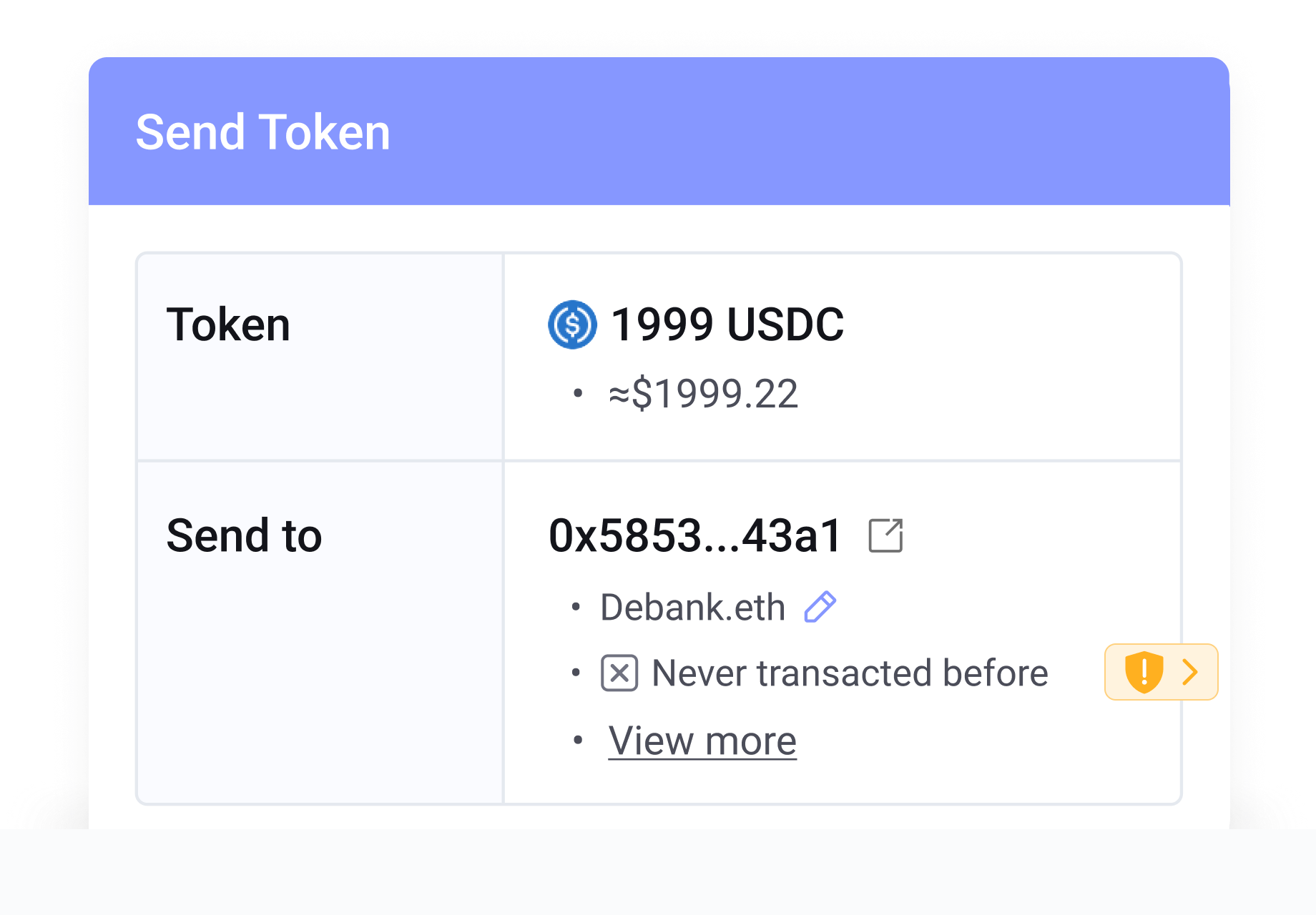
At the core of Rabby’s pitch is pre-transaction simulation: before your wallet signs a transaction, Rabby runs it against a local or remote execution engine to estimate the result — token transfers, contract state changes, and gas will be shown as concrete numbers rather than opaque hex blobs. Mechanistically, that’s similar to running a read-only call (eth_call) with the pending transaction data and then interpreting the returned state deltas. The benefit is immediate: the simulation converts a low-information decision (blind signing) into a higher-information one (displayed token balance changes and fee estimates).
Rabby complements simulation with a security engine that flags known-bad contracts (historically hacked addresses), suspicious approval requests, and impossible recipients. It also exposes an approval-revocation UI so you can cancel ERC-20 allowances — an important mitigation for one of the most common attack vectors where a malicious contract drains a wallet via a preexisting allowance. Another practical feature is automatic network switching: Rabby detects which EVM chain a dApp expects and switches the extension so you don’t sign on the wrong chain by accident. Finally, extensive hardware wallet support and integrations with institutional systems like Gnosis Safe are intended to fit Rabby into more conservative custody or operational setups.
Myth-busting: three things users usually misunderstand
Misconception 1 — “Simulation makes me immune to scams.” False. Simulations show a predicted outcome based on current chain state and the interpreted contract logic. They can’t magically detect economic deception (a malicious contract that does exactly what its code says but is still a rug) or warn about off-chain social-engineering. In short, simulation reduces technical blind spots but not all fraud vectors.
Misconception 2 — “Open-source and audits mean no vulnerabilities.” Not quite. Rabby is MIT-licensed and auditable, which increases transparency and external verification. That correlates with better security hygiene, but open source is not a substitute for secure design or ongoing monitoring. Rabby’s own history shows this nuance: a Rabby Swap smart contract was exploited in 2022 for about $190,000. The team froze the contract, compensated users, and stepped up audits — a textbook response — but the incident underscores that open-source code plus audits reduce risk; they do not eliminate it.
Misconception 3 — “Automatic network switching is risk-free convenience.” Automatic switching is convenient, especially when moving across over 90 supported EVM chains, but it creates its own vector: if a malicious or spoofed site forces a less-familiar network where you hold different tokens or have weaker defenses, automatic switching can lull you into a mistaken assumption about token balances or contract expectations. Always glance at the chain indicator; convenience should be paired with cognitive checks.
Installation and the first-hour checklist for the Rabby browser extension
Installing Rabby on a Chromium-based browser (Chrome, Brave, Edge) is quick, but security rests on a few small, repeatable steps. First, install from the official source and verify signatures if the project publishes them. Second, import or create your seed with hardware-wallet preference: if you use Ledger, Trezor, Keystone, or similar devices, pair it immediately — that reduces exposure by keeping private keys offline while you still benefit from Rabby’s UI. Third, toggle the ‘Flip’ feature if you plan to use Rabby alongside MetaMask: this lets you switch defaults without repeatedly entering seed data.
Fourth, run your first simulation on a small, low-stakes transaction: send a small ERC-20 swap or token transfer and compare the simulation output with on-chain result afterwards. This is an operational sanity check that validates the simulation pipeline on your machine and gives you confidence in reading Rabby’s output. Finally, use the approval revocation UI to clean up legacy allowances before interacting with new dApps — a short, high-leverage defense.
If you want a starting reference or install guide, you can find additional resources here.
Trade-offs and limitations that matter to U.S. DeFi users
Rabby’s set of protections trades complexity and surface area against convenience and ecosystem integration. Two important limitations: Rabby lacks an in-wallet fiat on-ramp and native staking features. For a U.S.-based user who wants to buy crypto with fiat or stake tokens in a single seamless UI, Rabby will require pairing with exchanges or custodial services. That’s a conscious product boundary: Rabby focuses on transaction integrity and multi-chain tooling rather than becoming a full-service exchange wrapper.
Another trade-off is the reliance on simulation engines and risk data feeds. These systems depend on up-to-date databases of hacked addresses, heuristics for suspicious approval patterns, and accurate RPC nodes for simulation. If feeds lag, or if you’re interacting with very new contracts that haven’t been analyzed, the risk engine’s alerts may be absent or incomplete. So while Rabby materially raises the bar for transaction visibility, it does not make them infallible — constant vigilance and layered defenses (hardware wallets, small test transactions, allowance hygiene) remain necessary.
How Rabby compares, in practice, with MetaMask and others
MetaMask is the dominant browser extension with deep ecosystem integration; Rabby distinguishes itself with pre-sign simulations, automatic network switching for 90+ EVM chains, a native revocation interface, and built-in gas top-up tools. Practically speaking, MetaMask’s ubiquity gives better dApp compatibility in edge cases, while Rabby’s security-focused UX reduces blind signing and approval risk. The sensible pattern for many DeFi power users is not an exclusive choice but a mixed workflow: use MetaMask where dApp compatibility dictates, Rabby when you want an extra safety layer, and hardware wallets across both for key protection.
Institutional users will also notice Rabby’s integrations with Gnosis Safe and custody providers allow it to be adopted within operational controls without sacrificing the pre-transaction visibility that operations teams care about.
Where Rabby might meaningfully improve security posture — and where to watch next
Rabby’s biggest, concrete improvement is behavioral: reducing blind signing. By transforming a complex hex payload into an explicit balance change, Rabby helps prevent many accidental losses. The approval revocation tool similarly changes the default posture from “allow and forget” to “allow, monitor, and revoke,” which is a big behavioral improvement for token safety.
Signals to monitor: continued accuracy and coverage of the security feeds (how fast newly exploited addresses are propagated), any new incidents and the response cadence, and whether Rabby expands on-chain heuristics (for example, flagging contracts that perform rapid value extraction patterns). If Rabby adds fiat rails or staking, that will change its threat model significantly; for now, the lack of those features keeps the scope narrow and, arguably, safer.
FAQ
Does Rabby prevent phishing sites from stealing my funds?
Not directly. Rabby’s pre-transaction simulation can reveal suspicious balance changes, but phishing remains a human-and-UX problem: a malicious site can trick you into approving legitimate-looking transactions. Use hardware wallets, verify URLs, and consider browser-level phishing protection alongside Rabby’s warnings.
Can I import my MetaMask wallet into Rabby safely?
Yes. You can import wallets by seed phrase or private key, and Rabby offers a ‘Flip’ toggle for quick switching between Rabby and MetaMask as default. Best practice: import to a hardware-backed account or transfer small amounts first while validating behavior.
Is the transaction simulation always accurate?
Simulations are accurate relative to the current chain state and interpreted contract logic; they can’t predict front-running, mempool reordering, or off-chain oracle manipulation that could change outcomes between simulation and confirmation. Treat simulation as a significant but not absolute guardrail.
What happens if Rabby flags a contract as previously hacked?
Rabby will alert you so you can refuse the transaction. The flag is based on known incidents aggregated from security feeds. That warning is valuable but not exhaustive; newly malicious contracts may be unflagged until feeds update.
Decision-useful takeaway: if your priority is transaction-level visibility, approval hygiene, and multi-chain ergonomics, Rabby materially improves the information available before signing. But it should be one layer in a defense-in-depth strategy — not the only one. For DeFi power users in the U.S., the most practical setup is Rabby plus a hardware wallet, conservative allowance management, and routine small test transactions when interacting with unfamiliar contracts. That configuration leverages Rabby’s strengths while acknowledging its limits.