
A wallet can support more than 140 EVM networks and still leave a user confused about what a transaction will actually do. That is the central paradox of modern DeFi: access has become easier faster than understanding has improved. For users in Germany and across the wider European market, where security, auditability, and careful custody decisions are often valued over novelty, the important question is therefore not simply whether a wallet connects to Ethereum, Arbitrum, Base, or the BNB Chain. It is whether the wallet can make the consequences of that connection intelligible before money moves.
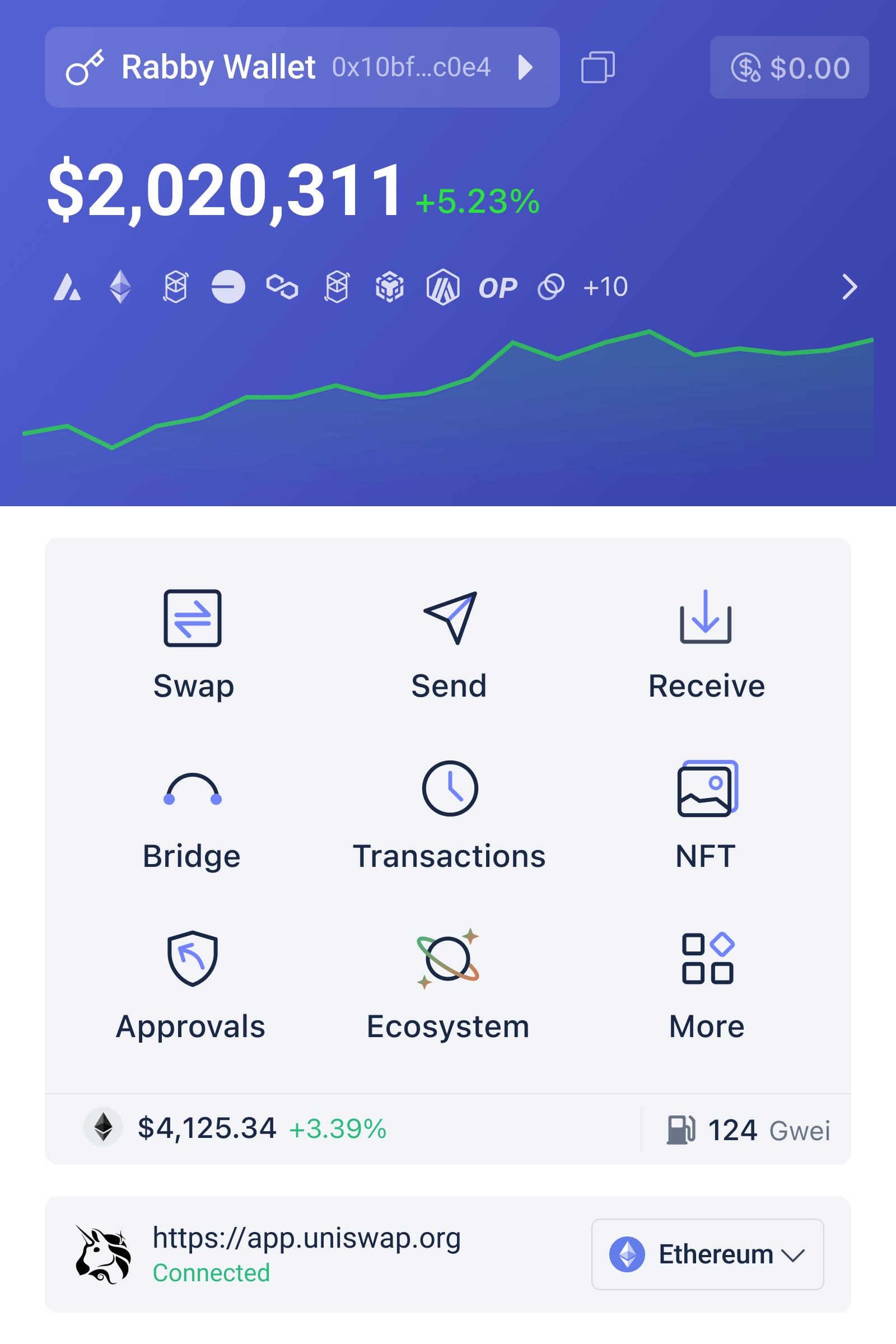
Rabby Wallet is interesting because it treats the wallet less as a passive key container and more as an interpretation layer between a user and decentralised applications. Its transaction simulation, security warnings, automatic network switching, swap routing, bridge integrations, and hardware-wallet support are designed around one practical problem: users rarely lose funds because they cannot click a button. They lose funds because the button means something different from what they believed.
From account manager to transaction interpreter
Early browser wallets were largely built around a simple model. The user selected a network, connected to an application, approved a request, and signed with a private key. That model was adequate when users interacted with a small number of familiar contracts. It becomes fragile in a multi-chain environment, where the same asset may exist in several representations, gas costs vary sharply, bridges introduce additional trust assumptions, and a single approval can allow a contract to spend tokens later.
Rabby’s main conceptual contribution is to place more scrutiny before the signature. Its simulation attempts to show the expected changes to token balances, while its security engine checks contracts and addresses for indicators such as phishing, known exploits, and potentially dangerous unlimited approvals. This is not a guarantee of safety. It is better understood as a pre-flight inspection: valuable because it can expose an inconsistency before execution, but dependent on the quality of the available information and the accuracy of the simulated environment.
That distinction matters. A simulation can describe what a transaction is expected to do under particular conditions; it cannot eliminate smart-contract risk, oracle failure, governance attacks, compromised front ends, or economic loss caused by volatility and slippage. Nor can a warning system identify every novel attack. The practical benefit is not perfect prediction. It is the creation of a pause in a market designed to make signing feel routine.
Users who want to examine the product before installing it can review the rabby wallet extension as part of their own verification process. As with any crypto software, downloading only from an authentic distribution channel and checking the requested permissions remain essential. A trustworthy interface does not remove the need for operational discipline.
Why multi-chain convenience creates a new security problem
Multi-chain support is often presented as a convenience feature, but it changes the cognitive demands placed on users. Rabby supports major EVM networks including Ethereum, Polygon, Arbitrum, Optimism, Avalanche, Base, and BNB Chain, alongside many other compatible networks. Automatic network switching can remove a common source of friction: manually selecting the correct chain when connecting to a decentralised application.
Yet less friction is not automatically safer. When a wallet changes networks on the user’s behalf, the user may become less conscious of which chain is active, which contract is being called, and whether the asset displayed by the application is native, bridged, or synthetically represented. The useful mental model is not “automatic switching equals automatic safety.” It is “automatic switching removes one class of error while making transaction review more important.”
Rabby’s integrated swap function addresses another layer of complexity. By scanning decentralised liquidity venues such as Uniswap and 1inch, it can seek competitive routes and reduce the need for users to compare platforms manually. The relevant trade-off is that the best quoted exchange rate is not the same as the best overall execution. Fees, price impact, route complexity, approval requirements, and the reliability of each involved contract all matter. A route with lower visible slippage may still expose the user to more operational or smart-contract complexity.
The same principle applies to bridging through integrations such as LI.FI. A bridge interface can make moving assets across networks feel like a single action, but the underlying process may involve several contracts, a liquidity provider, a message-passing system, or a change in asset representation. The interface simplifies the workflow; it does not simplify every underlying risk. Users should still ask what arrives on the destination chain, who controls the relevant infrastructure, and what happens if a route fails midway.
Gas Accounts and the changing meaning of usability
Gas is one of DeFi’s most persistent usability barriers. Each network generally requires its own native asset to pay transaction fees, so a user may hold USDC on a chain yet be unable to move it because the wallet contains no native token for gas. Rabby’s Gas Account feature aims to address this problem by allowing fees to be paid across networks with stablecoins such as USDC.
This is more than a convenience detail. It reflects a broader shift from chain-oriented user experience toward intent-oriented interaction. Instead of asking, “Do I possess the correct native token on the correct network?” the user asks, “Can I perform this operation with the assets I already hold?” That can reduce accidental lock-in and make smaller transactions more practical.
However, abstraction also hides dependencies. A gas-payment service must rely on conversion, sponsorship, routing, or settlement mechanisms that have their own availability and pricing conditions. Stablecoins themselves carry issuer, liquidity, and regulatory risks. For a user in Germany, the tax and accounting treatment of swaps, fee conversions, and cross-chain movements may also require careful records; a simpler interface does not necessarily create a simpler reporting obligation.
Non-custodial architecture and the limits of trust reduction
Rabby is designed as a non-custodial wallet, meaning private keys are stored locally on the user’s device rather than transmitted to Rabby’s servers. Its open-source architecture, released under the MIT licence, provides an additional basis for community inspection. The wallet also supports hardware devices such as Ledger, Trezor, and OneKey, allowing signing authority to remain isolated from the everyday browsing environment.
These properties reduce certain forms of counterparty risk, but they do not make custody risk disappear. A locally stored key can still be exposed through malware, a malicious browser extension, a fraudulent recovery phrase prompt, or poor backup practices. Hardware wallets protect the key material more effectively, yet the owner can still approve a harmful transaction if the displayed contract call is misunderstood. The decisive security boundary is therefore not only where the key is stored. It is also what the user is asked to authorise.
Rabby’s stated independence from its backend is relevant here. The wallet acts as an interface and verifier rather than secretly creating or modifying transactions, and core signing functions can remain available if Rabby’s servers are unavailable. That separation is reassuring, but it should not be confused with complete independence from infrastructure. Price data, security intelligence, simulations, RPC endpoints, bridge services, and decentralised applications may all depend on external systems. Resilience is layered, not absolute.
A practical framework for evaluating Rabby
For a DeFi user, the most useful evaluation is not a feature checklist but a sequence of questions. First, does the wallet expose the expected outcome clearly enough to compare it with the intended action? Second, does it identify approvals, recipients, networks, and contract interactions rather than merely displaying a green confirmation? Third, can the user preserve a stronger custody model through hardware signing? Finally, does the convenience of aggregation or automation obscure a risk that the user would otherwise have noticed?
On this framework, Rabby’s strongest case is its emphasis on transaction context. It attempts to turn signing from a cryptographic reflex into an informed decision. Its weaker boundary is the unavoidable one: no wallet can prove that a protocol will remain solvent, that a bridge will settle correctly, or that a newly deployed contract is safe simply because the interface displays it clearly.
Recent store messaging has continued to position Rabby as an open-source Ethereum and EVM wallet designed for DeFi and a smooth multi-chain experience. That direction is consistent with the broader evolution of the category. Wallets are becoming transaction operating systems: they route swaps, manage network changes, surface risk information, support cross-chain movement, and sometimes introduce loyalty systems such as Rabby Points for swaps, gas top-ups, or referrals. The open question is whether added intelligence will improve user judgement or encourage users to outsource it.
The most constructive near-term scenario is conditional. If simulations become more accurate, warnings become more specific, and users learn to inspect the difference between an expected result and a guaranteed result, wallets such as Rabby could materially improve DeFi’s safety ergonomics. If automation instead makes users sign more quickly without understanding permissions or bridge exposure, convenience may merely relocate risk. The signal worth watching is not the number of supported chains, but whether users can make better decisions because the wallet explains more of what is happening.
Frequently asked questions
Is Rabby Wallet safer than a conventional browser wallet?
It offers additional safety-oriented tools, including transaction simulation, contract and address warnings, approval-risk checks, hardware-wallet compatibility, and broad transaction context. These features can reduce avoidable mistakes, but they cannot guarantee that a protocol, bridge, token, or user-approved transaction is safe. Security still depends on the user’s device, recovery-phrase protection, contract judgement, and custody setup.
Can Rabby pay gas fees with stablecoins?
Its Gas Account feature is designed to let users pay network fees across chains with stablecoins such as USDC, even when they do not hold the native token required by a particular network. Availability, conversion conditions, fees, and supported routes should be checked at the time of use.
Does transaction simulation remove smart-contract risk?
No. Simulation estimates the expected state change before signing, which can reveal suspicious transfers, unexpected approvals, or mismatches between an application’s description and its requested action. It cannot forecast every exploit, economic failure, oracle problem, or future change in a contract’s behaviour.
Who is Rabby most suitable for?
It is particularly relevant for users who interact with several EVM networks and want stronger transaction review than a basic account interface provides. Beginners may benefit from the explanations, while experienced users may value aggregation and hardware-wallet support. In both cases, the wallet works best as a decision aid, not as a substitute for understanding DeFi mechanics.